Friday
Mixed Media
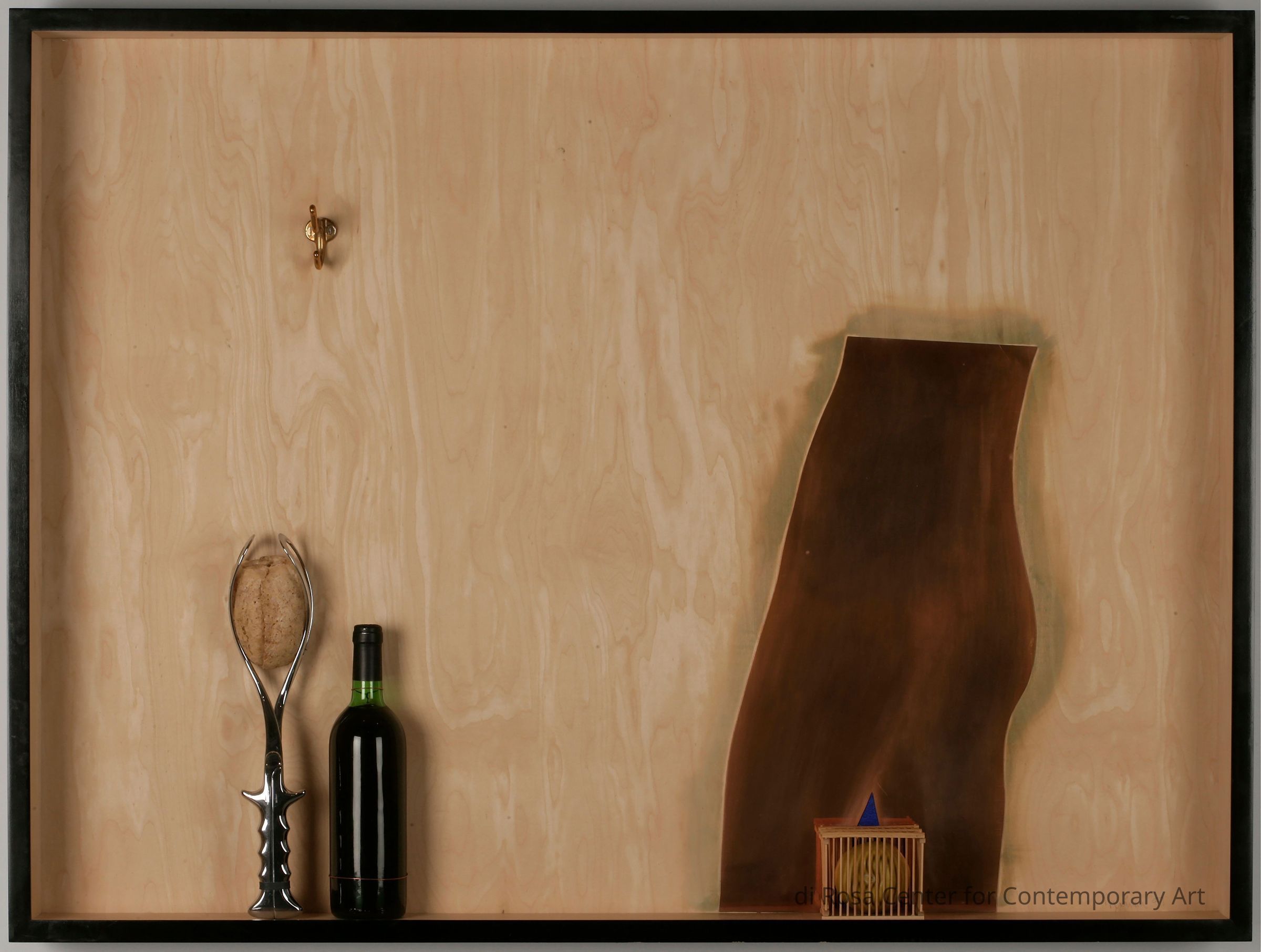
Shadow box containing inter alia silhouette of female torso, bottle of wine, and clamp holding French roll
1025
Shadow box with mixed media
Sculpture
AR1025
Fuller Gross Gallery
Purchase
Tom Marioni
1989
Object
36 in
48 in
4-1/4 in
The Incorrect Museum: Vignettes from the di Rosa Collection
April 17, 2021- April 17, 2022, di Rosa Center for Contemporary Art, Napa
Based on a True Story: Highlights from the di Rosa Collection
October 26, 2016 - October 15, 2017, di Rosa Center for Contemporary Art, Napa
Found: Everyday Objects in Bay Area Art
August 20 - October 1, 2005, di Rosa Center for Contemporary Art, Napa
Curator
2016
Tom Marioni opened the Museum of Conceptual Art in San Francisco in 1970 as a place where experimental art would not be suppressed (in 1971, for instance, the Guggenheim canceled a show by Hans Haacke and censored Daniel Buren’s contribution to an international exhibition). The museum was a formative site for exchange and dissemination of Conceptual art practices and supported Paul Kos, Bruce Nauman, Dennis Oppenheim, and many others—including a few women, notably Barbara Smith and Linda Montano—during its fourteen-year existence. Marioni’s early interest in social sculpture, such as The Act of Drinking Beer with Friends Is the Highest Form of Art (1970–ongoing), brought new approaches to Conceptual practice. His neatly arranged shadowboxes, such as Friday (1989), presented here, were made after he declared Conceptual art dead in the mid-1980s, and nod in various ways to the concerns of material and subject that are woven throughout his career. A strong interest in place, everyday life, and actions emerged as primary materials for the Conceptual artists Dennis Oppenheim, Paul Kos, and Robert Kinmont, who in the 1960s and 1970s sought to create new contexts for contemporary art outside the gallery walls. The objects on view here by Oppenheim and Kos are residue of the work itself, symbolic of site and action. For his series Site Marker #1-#10 (1967), Oppenheim chose ten sites on the outskirts of New York, then packaged up a photograph of each location with a map indicating how to get there and a description of the destination, accompanied by an official aluminum site marker. The description for Site Marker #10 reads, “Tar and Wood Cover for Rectangular Pond,” and indicates that it is located off Route 25A on Long Island. The site, at the moment of Oppenheim’s capturing it, became a work of art. Kos began his experimentation with site-specific works at di Rosa with Lot’s Wife (1968–69), which signaled a shift to natural materials that later pervaded much of Bay Area Conceptual art. Like many other Conceptual artists, David Ireland became interested in creating unflinchingly noncommercial artwork. He turned his San Francisco residence into its own form of art institution, using home as a place for site-specific interventions. His background as an architect often influenced his explorations of materials and forms, as well as the strong connection he perceived between art and life. An investment in using everyday materials connected the Bay Area Conceptual artists, and this impetus carried through to the next generation of artists and alternative spaces that rejected the commercialization of art and art-market trends.