
Homo-Beef
Painting
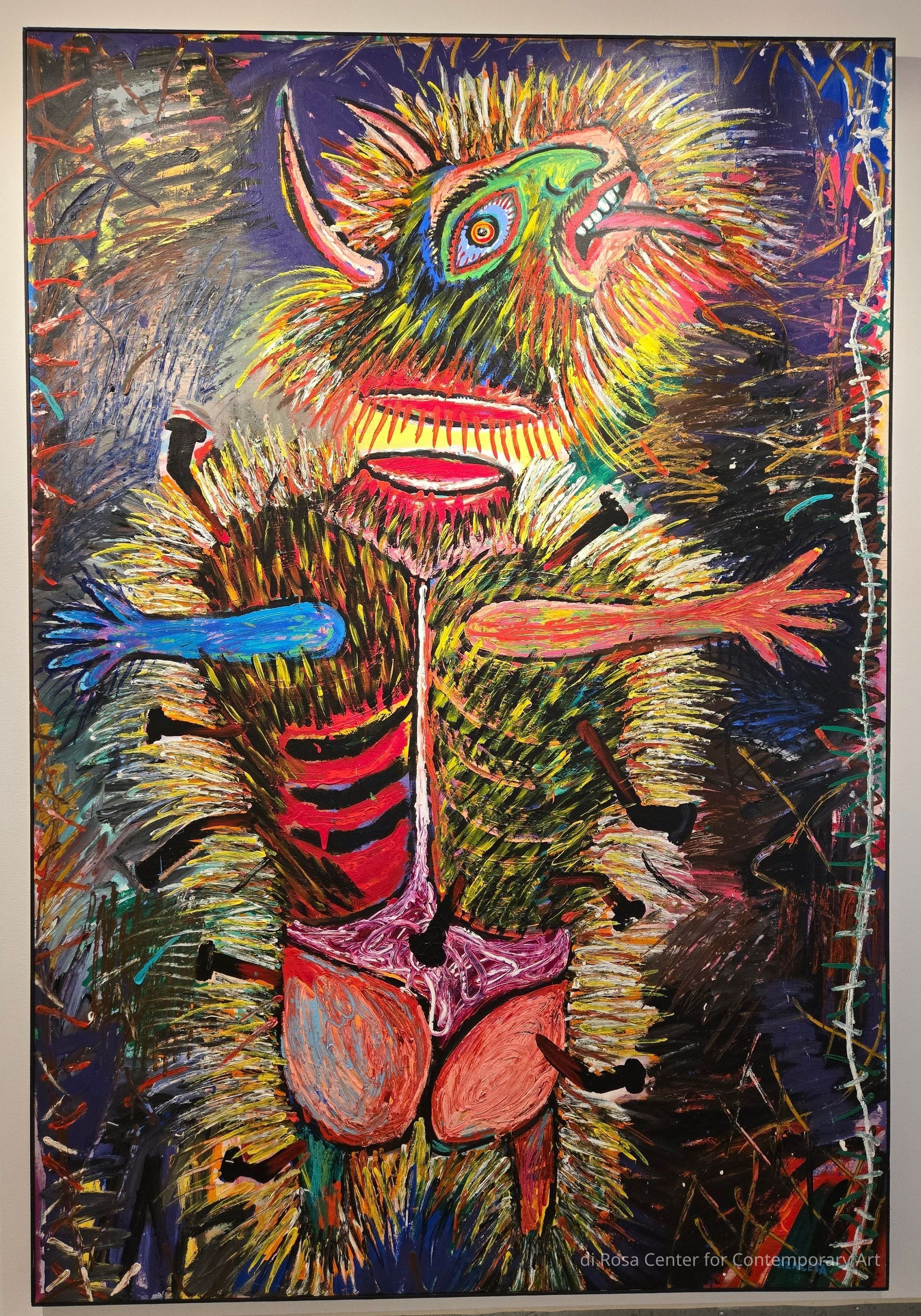
Man/cow with severed head
463
Acrylic
On canvas
Painting
AR463
Allan Frumkin Gallery
Purchase
Luis Cruz Azaceta
1983
Signature
Recto, lower right
Azaceta
Painted
Cattle, Beef
Object
96 in
65-1/2 in
The Incorrect Museum - Ongoing
May 3, 2025 - Ongoing, di Rosa Center for Contemporary Art, Napa
Meridian: An Exhibition of the Art of the Americas
July 9 - August 10, 1985, San Francisco Arts Commission Gallery, SF
Collections Manager
Katie Kime
2026
Luis Cruz Azaceta Born in Havana, Cuba in 1942 During his childhood, Azaceta was witness to the political violence in Cuba. He immigrated to New York when he was 18 and got his degree at the School of Visual Arts. Azaceta had displayed artistic talent from a very early age, but this was the first time he was able to pursue it as a career. In the 1970s he was introduced to Peter Saul and Robert Arneson, and you can see some of their influences in early works. He self-described his work as “apocalyptic pop”. Thematically, Azaceta explore depictions of refugees, dictators, victims of dictators, urban violence, the AIDS epidemic, and war and terrorism in his artwork. The AIDs crisis, in particular, was a prominent topic for his works in the 1980s. He wanted to show the ugliness of the world to help bring attention to violence and tragedy, and in turn, hopefully bring about change. " "I am a potential murderer and also a potential comedian and my paintings are the result of these potentialities. My works are a tragi-comic outcry at Man’s Condition – a Slaughterhouse World of Violence, Cruelty, Madness Absurdity. Through my art I try to communication some kind of consciousness about this condition 'Abrigando Una Esperanza.’ The last bit is important to the meaning – ‘Abrigando Una Esperanza’ means “embracing a hope” “ - Quote from the Allan Frumkin Gallery Newsletter Fall, 1979 “My intention is to create compassion. The vehicle for compassion is the aesthetic that draws one into looking closely at what are, perhaps, sometimes horrific subjects and embracing them.” - Artist Statement from website Along with all of these reactions to violence – he was also experimenting with particularly in his adaption of self-portraits that, as hybrid, mechanized creatures, empathetically depict the “other.” We can see this in "Homo-Beef". The cow figure is a form of self-portrait and the pipes sticking out of the creature’s sides are the mechanical elements. The nose and “bristly” mustache is a theme in much of his earlier work and is often a self-portrait. Other examples of this hybridization include, "Homo-Fragile", 1983 and "Self-Portrait as Mechanized Doggie", 1984 Azaceta currently lives in New Orleans, Louisiana. His current practice is more abstracted – examples can be found on his website.