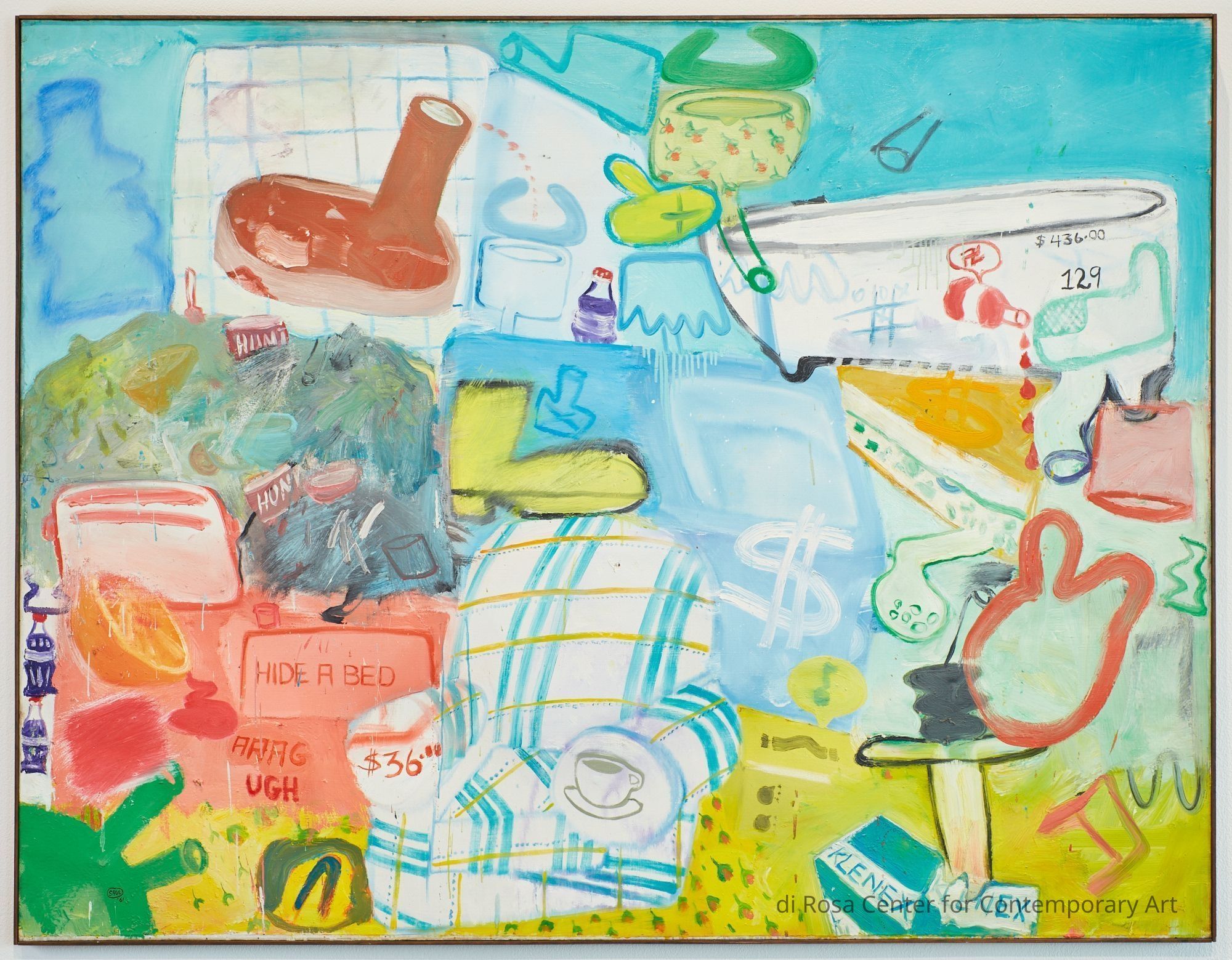
Master Room (Hide a Bed)
Painting
Scattered room objects and American consumer items with dollar signs and 'Hide-a-Bed' inscribed; objects include red bed and blue and white plaid chair
416
Oil on Canvas
Painting
AR416
Allan Frumkin Gallery
Purchase
Peter Saul
1961
Signature
Date
Recto, lower left
Saul '61
Object
60 in
77 in
Far Out
August 2 - October 4, 2025, di Rosa SF
The Incorrect Museum - Ongoing Salon
August 8, 2023 - July 23, 2025, di Rosa Center for Contemporary Art, Napa
The Incorrect Museum: Redux
May 13, 2022 - February 26, 2023, di Rosa Center for Contemporary Art, Napa
The Incorrect Museum: Vignettes from the di Rosa Collection
April 17, 2021- April 17, 2022, di Rosa Center for Contemporary Art, Napa
Building A Different Model: Selections from the di Rosa Collection
March 9 - December 29, 2019, di Rosa Center for Contemporary Art, Napa
Relax in Electric Chair: Peter Saul at di Rosa
March 4 - July 26, 2015, di Rosa Center for Contemporary Art, Napa
Curator
2016
Peter Saul reached to the cultural realm for inspiration in his narrative paintings. The early (Master Room) Hide-A-Bed (1961), featured on the cover of Art in America that same year, shows an arrangement of semi-cartoonish household objects, anticipating the late work of Philip Guston as well as the rumblings of Pop art. As Saul’s work developed, his style veered toward the grotesque, amplifying his often overtly political subject matter in surrealist, playful, provocative mash-ups.