
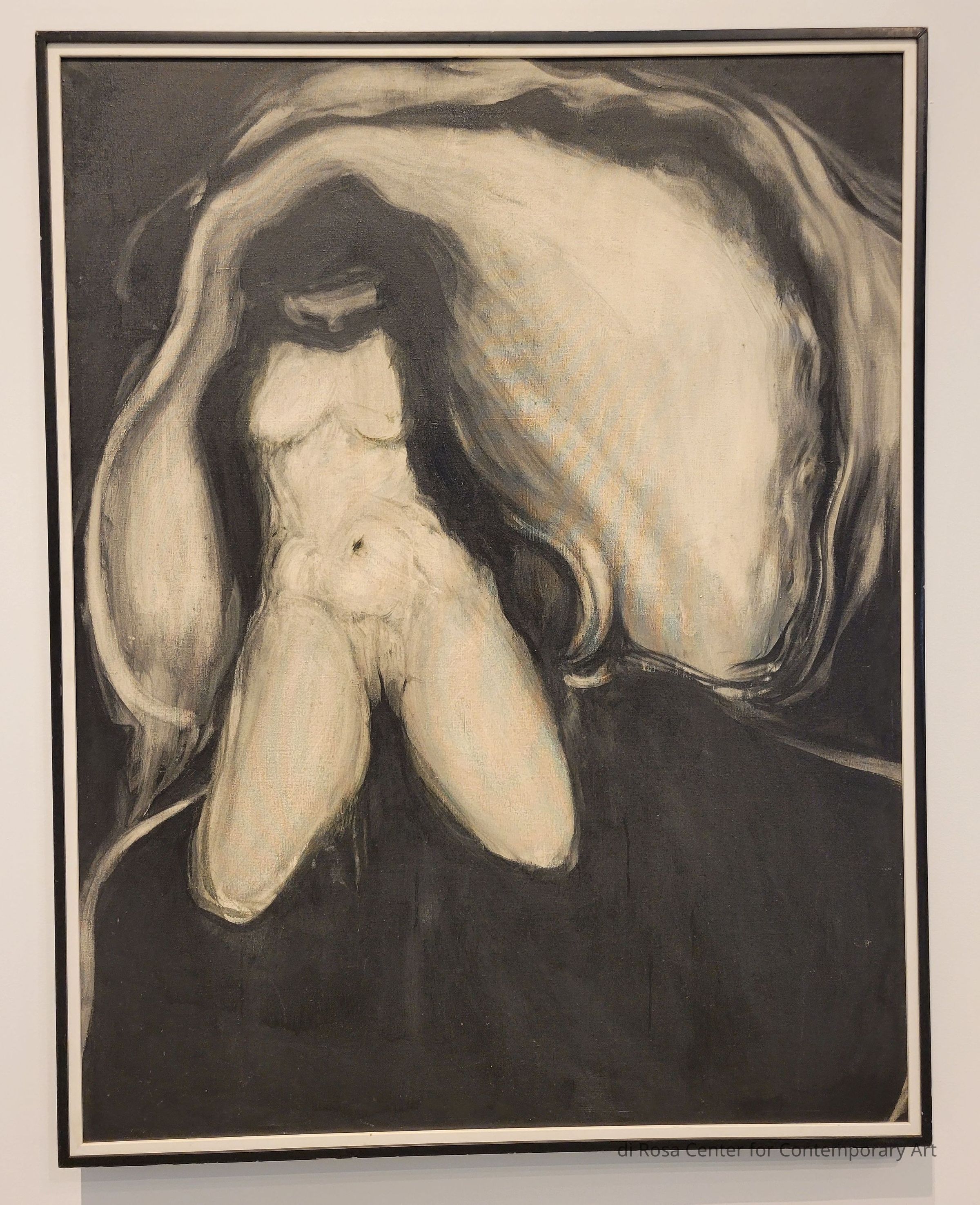
VENUS, JULY 6, 1958
Painting
Kneeling female nude with head bowed and cloud-like form enveloping her; black and white with a few green brush strokes on torso
833
Oil on Canvas
Painting
AR0833
Anglim/Trimble
Purchase
Credit Line: © Conner Family Trust, San Francisco, and Artists Rights Society (ARS), New York
Bruce Conner
1958
Object
54 in
42 in
Totem di Rosa
Friday, March 3, 2023 - Sunday, July 30, 2023, Napa, CA
The Incorrect Museum: Redux
May 13, 2022 - February 26, 2023, di Rosa Center for Contemporary Art, Napa
The Rat Bastard Protective Association
October 1 2016 - January 7, 2017, The Landing, Los Angeles
Renaissance on Fillmore 1955-65
November 3, 2012 – January 27, 2013, di Rosa Center for Contemporary Art, Napa
Curator
2022
Conner’s Venus became the subject of a widely reported obscenity scandal when, in 1958, it was hung in the window of San Francisco’s Designers’ Gallery. Officer John H. Monson, the Examiner reported, “ordered the picture removed from public view after a housewife complained that neighborhood children must pass the painting on their way to school. ‘It isn’t art,’ he said. ‘It leaves nothing to the imagination.’” Conner, ever-defiant, nevertheless insisted on the work’s reinstallation, informing the paper: “The officer has a dirty mind. And you can quote me.” The incident was ultimately investigated by the SFPD. Conner, like his contemporaries Ginsburg, McClure and Ferlinghetti, courted the politics of obscenity; embracing a frank, metaphysical view of human sexuality that defied the rigid social codes of 1950s America and advocating an absolutist stance on first amendment issues that remains controversial today.