
Woman Preparing for a Shower
Painting
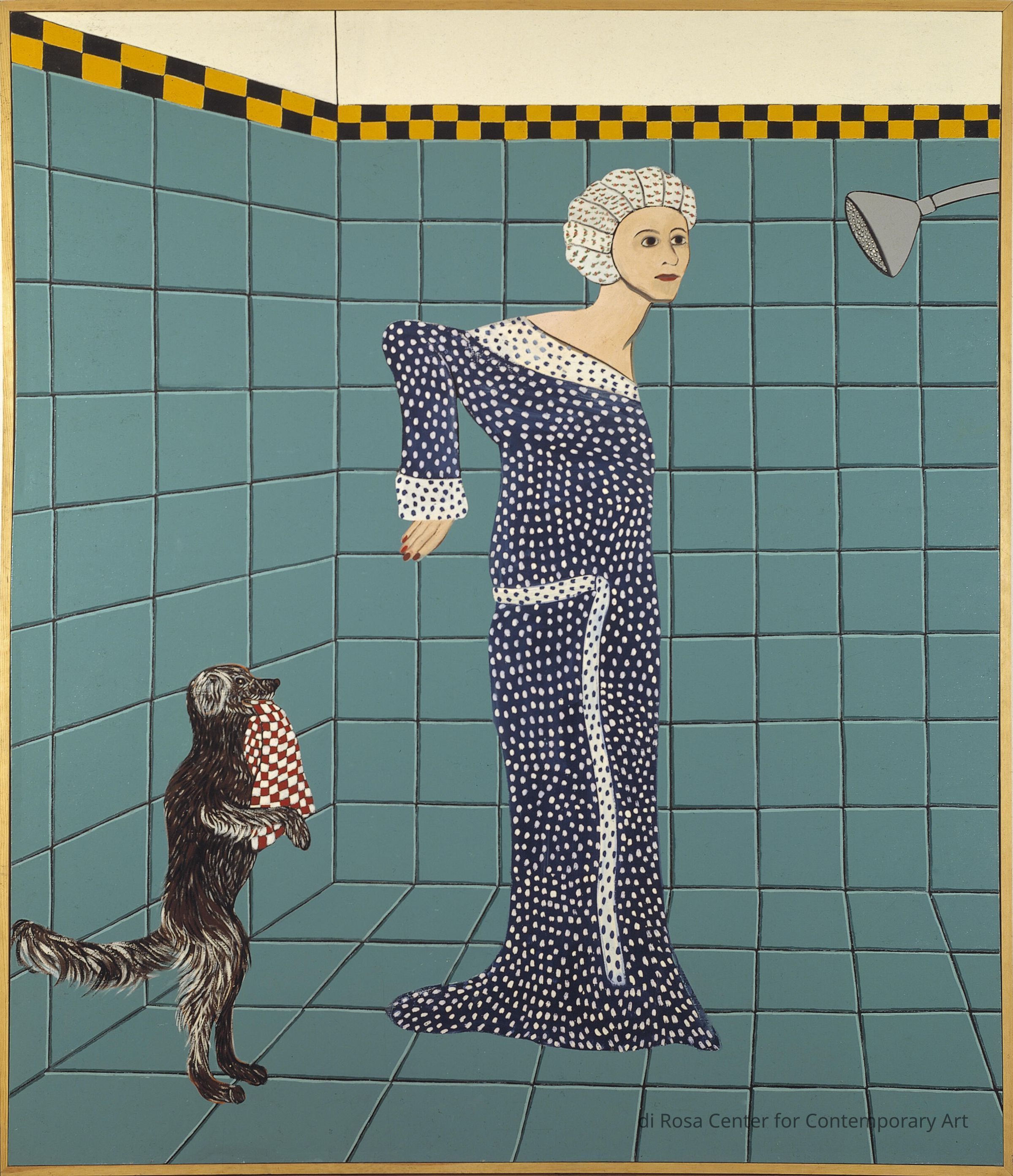
Woman in black and white robe and shower cap standing in blue tiled shower; dog standing on hind legs with towel in mouth
227
Enamel on canvas
Painting
AR227
Allan Frumkin Gallery
Purchase
Joan Brown
1975
Signature
Title
Date
Verso, center, stretcher board
Joan Brown / "Woman Preparing for / a Shower" / July 7, 1975
In Artist's Hand
Dogs
Bathing
Object
84 in
72 in
Far Out
August 2 - October 4, 2025, di Rosa SF
Joan Brown
November 19, 2022 - March 12, 2023, SF MoMA; May 27, 2023 - September 24, 2023, Carnegie Museum of Art, Pittsburgh, PA; February 7, 2024 - May 1, 2024, Orange County Museum of Art, Costa Mesa, CA
To Begin Again: A Pre-History of the Wex,1968-89
February 5 - May 8, 2022, Wexner Center for the Arts, Columbus, OH
Building A Different Model: Selections from the di Rosa Collection
March 9 - December 30, 2019, di Rosa Center for Contemporary Art, Napa, CA
The True Artist is an Amazing Luminous Fountain
April 21 - July 31, 2004, Kreeger Museum, Washington D.C.; September 12, 2004 - May 8, 2005, di Rosa Center for Contemporary Art, Napa; June 21 - August 14, 2005, Palm Springs Art Museum; October 8 - November 27, 2005, Santa Cruz Museum of Art and History
Joan Brown’s paintings from around this time often depicted dancers or nights out, making this a rare “before” portrait. It is also anomalous in her oeuvre because it is not explicitly of the artist herself. Yet we still see Brown engaged with the compositional issues regarding interior spaces that she was exploring in other works from this period. The woman is alone in a space that is both a vast, patterned expanse and an oddly claustrophobic corner. The dog, modeled on Brown’s own Rufus, both waits for and entertains her. It is a portrait of life in solitary motion.