
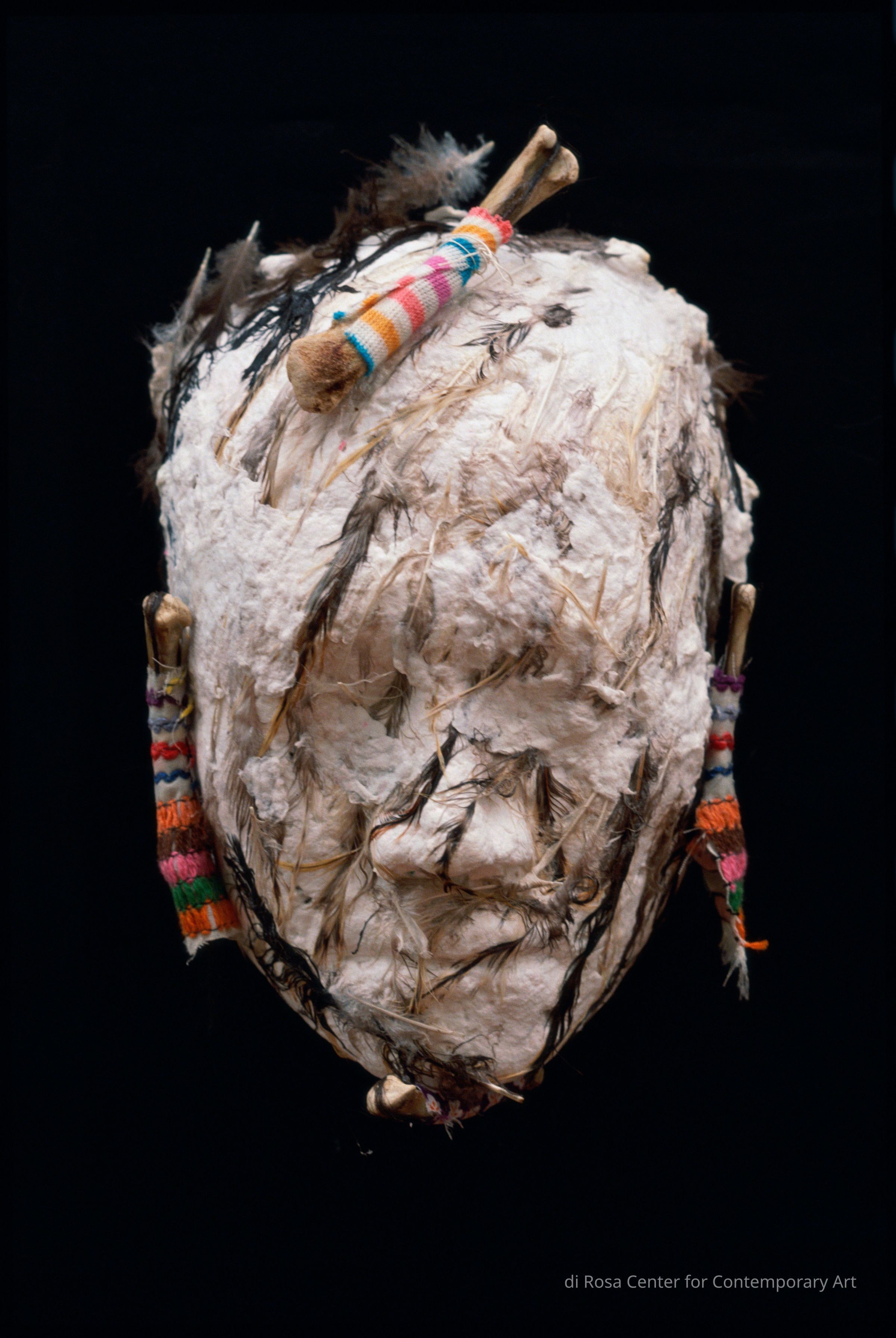
Head with Bone Dolls
Sculpture
White paper mask with feathers and three bone dolls at ears and forehead
489
Paper pulp, feathers, bones
Sculpture
AR489
Janet Steinberg Gallery
Purchase
Carlos Villa
1982
Signature
Date
Verso, proper left
Carlos Villa / 82
Feathers
Object
9-1/2 in
7 in
4 in
Plexi Display Box
14-1/2 in
14-1/2 in
8 in
Born in 1936 in San Francisco, Carlos Villa received his B.F.A. from the San Francisco Art Institute and his M.F.A. from Mills College, Oakland. He was a professor at C.S.U. Sacramento and S.F.A.I.
Together Again
August 2026 - August 2027, Jan Shrem or Maria Manetti Shrem Museum of Art, Davis, CA
Carlos Villa: Worlds in Collision
February 8 - May 8, 2022, Newark Museum of Art, NJ; June 17 – October 24, 2022, Asian Art Museum, San Francisco
Building A Different Model: Selections from the di Rosa Collection
March 9 - December 30, 2019, di Rosa Center for Contemporary Art, Napa, CA,
Curator
2019
Carlos Villa trained alongside William T. Wiley, Joan Brown, William Allan, and Manuel Neri in aesthetic modes he would later bring into dialogue with Minimalist sculpture and his own Filipino heritage. Villa sometimes used his sculptures in performances in the 1980s. These works advance ideas of sculptural space, the artist as shaman, and the very notion of what art can do. But Villa was adamant that his heritage not be the only lens through which his work was viewed. He likened his approach in this sense to, say, Bruce Conner’s unheralded identity as an Irish American. It’s there if you are looking for it, but ultimately the work is a fulsome expression of complexly woven strains of cultural identity.