
Music Box - Japanese Movements
Sculpture
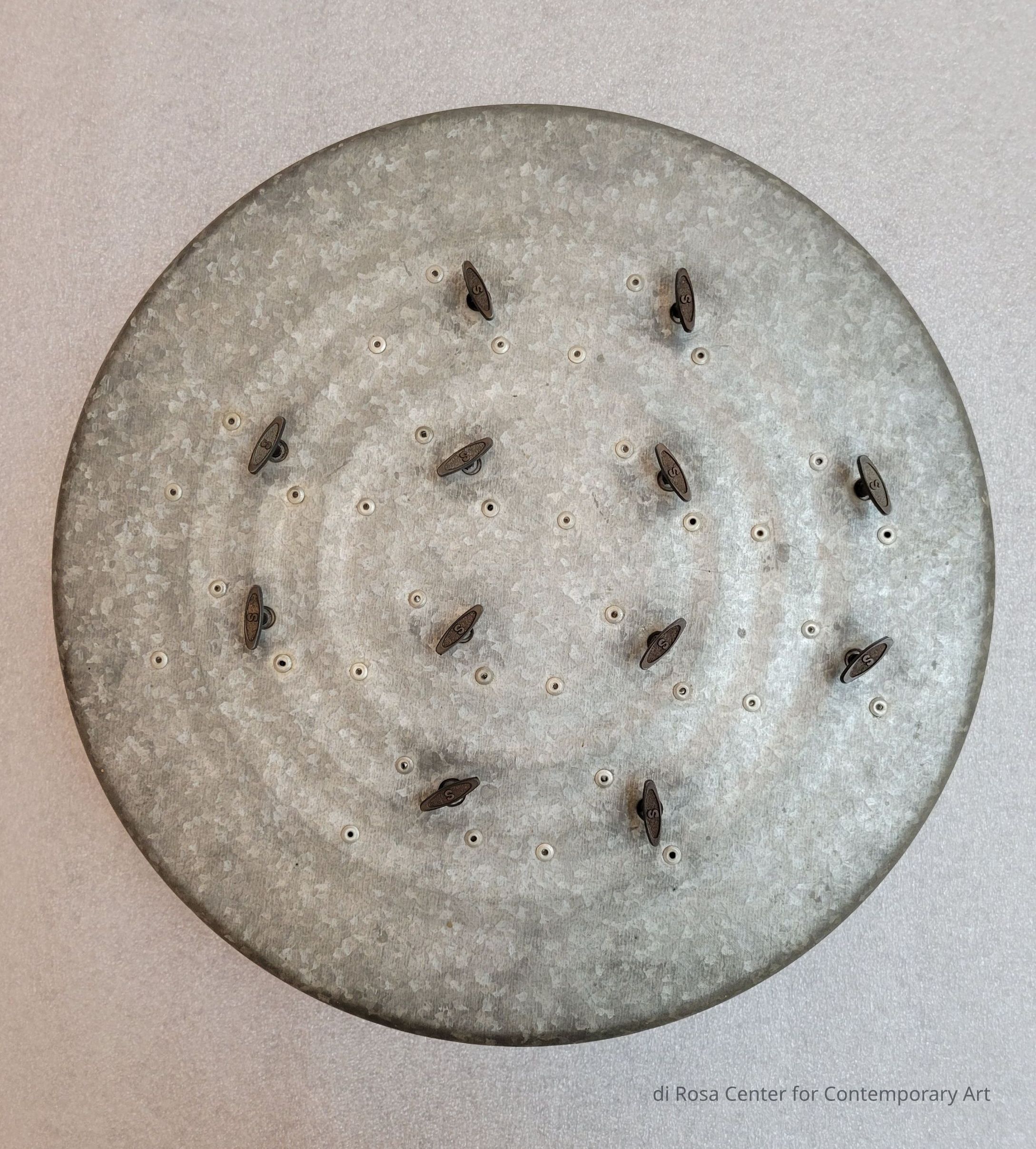
Galvanized oil pan with 12 winding keys on outside of bottom of pan; movements inside pan
216
Galvanized steel pan and music box movements
Sculpture
AR216
James Pomeroy
Purchase
James Pomeroy
1974
Music boxes
Sounds
Object
14-1/2 in
14-1/2 in
4-1/2 in
Be Not Still: Living in Uncertain Times (Part 1)
January 27 - Sunday, May 27, 2018, di Rosa Center for Contemporary Art, Napa
Curator
Twyla Ruby
Jun 20, 2023
Pomeroy's earliest sound-making devices, based on stripped music-box movements, give us the Boy Mechanic involved with both mechanical and contextual tinkering. The still-sculptural sound installation Fear Elites (1974) was a framed but unwalled room made of sheet-metal studs. The structural members were adorned with dozens of tiny music-box mechanisms, which had been modified and amplified in various ways - cylinders and combs had been inverted or reversed, tines removed from the combs, or objects inserted into the mechanisms--all serving to alter the sound and defy the rote musicality of a single melody, in this case Beethoven's trite bagatelle "Fur Elise." This room-sized automatic mechanism required the participation of the viewer to wind the mechanisms and activate the sound. Once started, the nonexistent walls resounded with amplified tinklings and fragments, outlining a melody that is familiar, but never quite coalesces, dispossessed as it is of both musical and physical site. The same music-box technology was applied to the performance device Mozart's Moog of the same period. A briefcase crammed with 44 music-box movements mounted on a brushed-aluminum panel presented the user with an array of winding knobs much like the controls on analog electronic music synthesizers of that day. Some of the music-box mechanisms were "prepared," in the style of John Cage's piano modifications, to alter their sound from tonal to percussive qualities. A number of contact microphones attached to the face panel further transformed the sounds electrically and conducted them to audio outputs, and from there to an amplifier. The instrument was played by winding, starting, stopping, and "scratching" (hip-hop fashion) the music-box mechanisms. The enduring problem of live electronic (and now computer) music - what place does human gesture have when all a performer does is press buttons and turn knobs - was brushed aside elegantly by Pomeroy. His placement of the contact microphones ensured that all performative actions were amplified as well, resulting in a sonic conflation of intention, mechanism, and meaning.